
Oral language FAQs
Language is a structured system of communication shared by a community. The two major components of language are words (vocabulary), and the rules for modifying and combining them (grammar).
Language can be understood and expressed through speaking, writing, signing, and picture symbols.
Oral language is the system through which we use and understand spoken words. Oral language skills are important as they support a child's ability to communicate. They also support a child's ability to:
-understand and express emotions (socio-emotional development)
-think and learn
-solve problems and make meaning out of the world around them
-develop and maintain relationships and connections with others.
Please read the FAQs below to learn more about oral language.
Download a printable version of this page by clicking below.


How does oral language develop?
Children learn language by hearing it used around them and (most importantly) being included in interactions and conversations.
Communication development is more than just words. There are a range of skills that are foundational for oral language learning. Please see the communication development pyramid below.
The skills in each layer of this pyramid support the development of the skills in the layers above.
.png)
My child is bilingual - does this cause language delays?
In Aotearoa, a recent study has found that at two years of age 40% of children understand two or more languages, while some children (7%) understand three or more.
Many parents believe that if their child is being raised with two or more languages in the home (or one at home and one at school), they will experience confusion which could impact their development. Even though this is untrue, this misguided belief has lead to some families being told to limit their child's exposure to just one language.
Contrary to the idea that bilingualism causes confusion or language delay, there is actually evidence that bilingualism has some major benefits:
-Bilingual people, (including children) have been shown to have enhanced "cognitive flexibility" - a skill that allows people to see things from multiple perspectives. -Bilingual people can discriminate the sounds of languages more finely than monolinguals.
-Studies have also shown that bilingual individuals mature earlier than monolinguals in the area of linguistic abstraction - the ability to think and talk about language.
At Eden Speech & Language Therapy, we recognise the importance of having access to rich linguistic input, and the vital role that home languages play in building identity and connection. This is why we encourage families to speak to their children in the language or languages they are most comfortable speaking.

I've been told that my child needs support with their language development. What are my options?
You have a number of options:
-Get your child's ECE teacher/centre to make a referral on your behalf to Learning Support at the Ministry of Education (MoE). More information on this here.
-You can also self-refer to the MoE by calling
0800 622 222 or emailing Special Education on special.education@education.govt.nz
-You can talk someone at Plunket. Here is a link to a page where you can search for Plunket services in your area.
-You can chat to your GP or paediatrician about any concerns you have.
-This Talk Tools resource provides some great strategies to get you started in supporting your child at home, or you can read the next section below for some great tips.
-You can contact a private speech therapist to have a chat about your child's language development.
What can I do at home to support my child’s oral language development?
The best way to encourage your child’s language development is to do a lot of talking together about things that interest your child.
Some simple but very effective strategies to help you get the most out of your time together are:
Watch, wait and listen. What is your child noticing? Where is their attention? What sounds are they making? Then...
...follow your child's lead. Get down to their level (if you can) and join in with their play. To get an interaction going, you can imitate their actions. For instance, if your child is stacking blocks, you can add a block on top or start building a tower yourself.
Comments not questions. Make simple comments about what is happening. "I see a red block!" "Oops - it fell down!". "I'm rolling the ball!"
Interpret their meaning. If your child communicates without words, try to put words to their actions. If they point at a toy they want, you could say "oh, you want the train!"
Expand their meaning. If your child communicates using single words, then you can repeat that word back to them, adding 1-2 more words to make a phrase. Child: "train", parent: "big red train", or "train goes choo-choo!"
Sing, make funny noises, and recite nursery rhymes. These are all great activities for learning language, and also support speech sound development.
Look at books together. You don't even have to read the whole story - just looking at the pictures and talking about them is a great way to model language and to support your child's emerging identity as a reader.

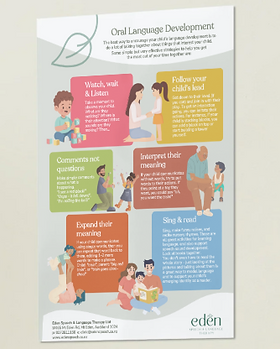
Download a copy of these tips

What is the connection between oral language and literacy?
Literacy development begins long before a child goes to school. Learning to understand, use, and enjoy language is the first step in literacy and forms the basis for learning to read and write.
Children’s vocabulary at age 2 is strongly linked to their literacy and numeracy achievement at age 12, and delays in oral language in the early years are reflected in poor reading comprehension at school.
The Growing Up In New Zealand Study - a longitudinal study of child development in New Zealand has discovered that 20% of children are struggling with oral language skills at age 5.
The same study found that 59% of ECE teachers report that COVID-19 had had an impact on the oral language development of their students, with 65% of new entrant teachers reporting the same.